Perse — work management without an agent hierarchy
the line itself: an ask becomes a Form, scheduled lanes build and check it, and the outcome is recorded before the next pass.
The problem
Architecture

One decision
Memory lives in Postgres as insert-only records, not in the model’s context window. Every observation is written before the next step is taken.
Long-lived sessions carrying the state in context. Rejected because the state died with the session and could not be audited afterwards — the one property the whole system exists to provide.
Three features
The supply of intelligence is separate from the authority over it: a non-deterministic model works inside deterministic controls that sit outside the model.
Established identity and limited privileges per harness. A harness registry and elections decide which lane may act on which repo, and each lane works under its own limited scope.
Containment, with a human pause. Frozen Forms and owner gates hold work still until the operator rules, and changes to the deploy surface or to the rules themselves always wait for a human read.
Independent auditability — no model verifies its own work. Verdicts are recorded by a lane other than the one that built, and premise rechecks park any work whose ground has moved under it.
Every meaningful action leaves evidence. Outcome receipts and session ledgers record what each lane did as tamper-evident, human-readable rows.
Evidence: Satya Nadella, Models as Insider Risks in the Super Intelligence Era (2026-10-10); the harness registry, lane verdicts and outcome receipts of this workspace.
Eight processes a strong model runs inside one context run instead as Perse structure, deterministically, at no token cost — so the judgment lives in the substrate, and a mid-tier model delivers at a top-tier rate.
Recall. The wiki and the board carry the record; a lane boots from pages and rows, never from what a model happens to remember.
Verification. Build, test and verdict gates run as structure, not as a second pass by the model that wrote the code.
Refutation. Refute-first shaping and premise rechecks attack the ground of a Form before any lane builds on it.
Consistency with prior decisions. Standing decisions and rulings are rows every lane reads, so a settled question stays settled.
Decomposition and persistence. Work is cut into Forms with acceptance criteria, and every outcome is an insert-only record that outlives the session.
No decision without a row. A decision becomes a row Perse can refuse when it is incomplete: rationale, evidence and acceptance are fields, not hopes.
Evidence: vision bb71131f, Perse amortizes max; the overnight run in which a cheaper model merged 33 PRs with zero reverts inside the substrate, while every orchestrator miss that week happened outside a Form (operator record, 2026-10-12).
Several harnesses work the same board at the same time, coordinating through shared artifacts rather than shared memory — stigmergy, the way ants coordinate through the environment.
Coordination through the environment. The wiki, the Forms and the session ledgers are the shared surface: each lane leaves its state where the next lane reads it.
Authority and methodology live in rows and pages. Elections, gates and the canonical routine pages are workspace records, so both transfer to a new harness with zero rework.
A new harness boots from the wiki alone. The reading list and the routine pages carry the whole operation; no model memory is load-bearing.
Evidence: on 2026-10-12 a new harness took over this board end to end the same evening it first read the wiki, and its lanes shipped under the same gates (session ledgers, workspace wiki).
See it
3 frames · select a frame to swap the hero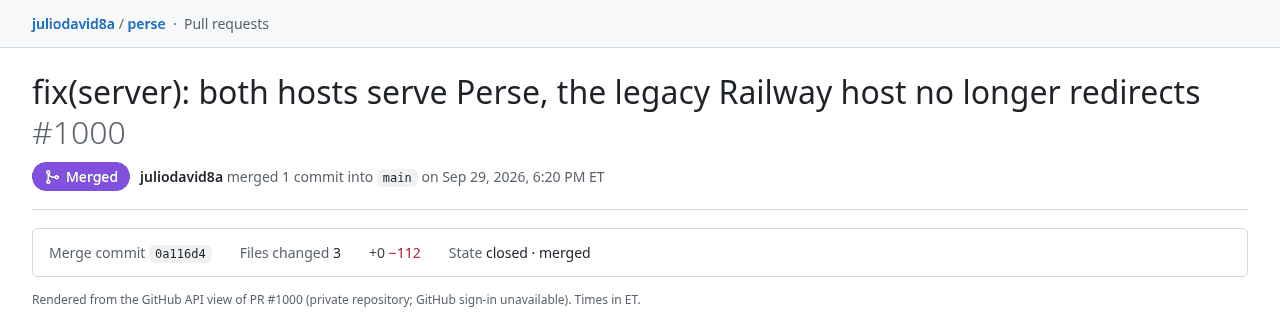
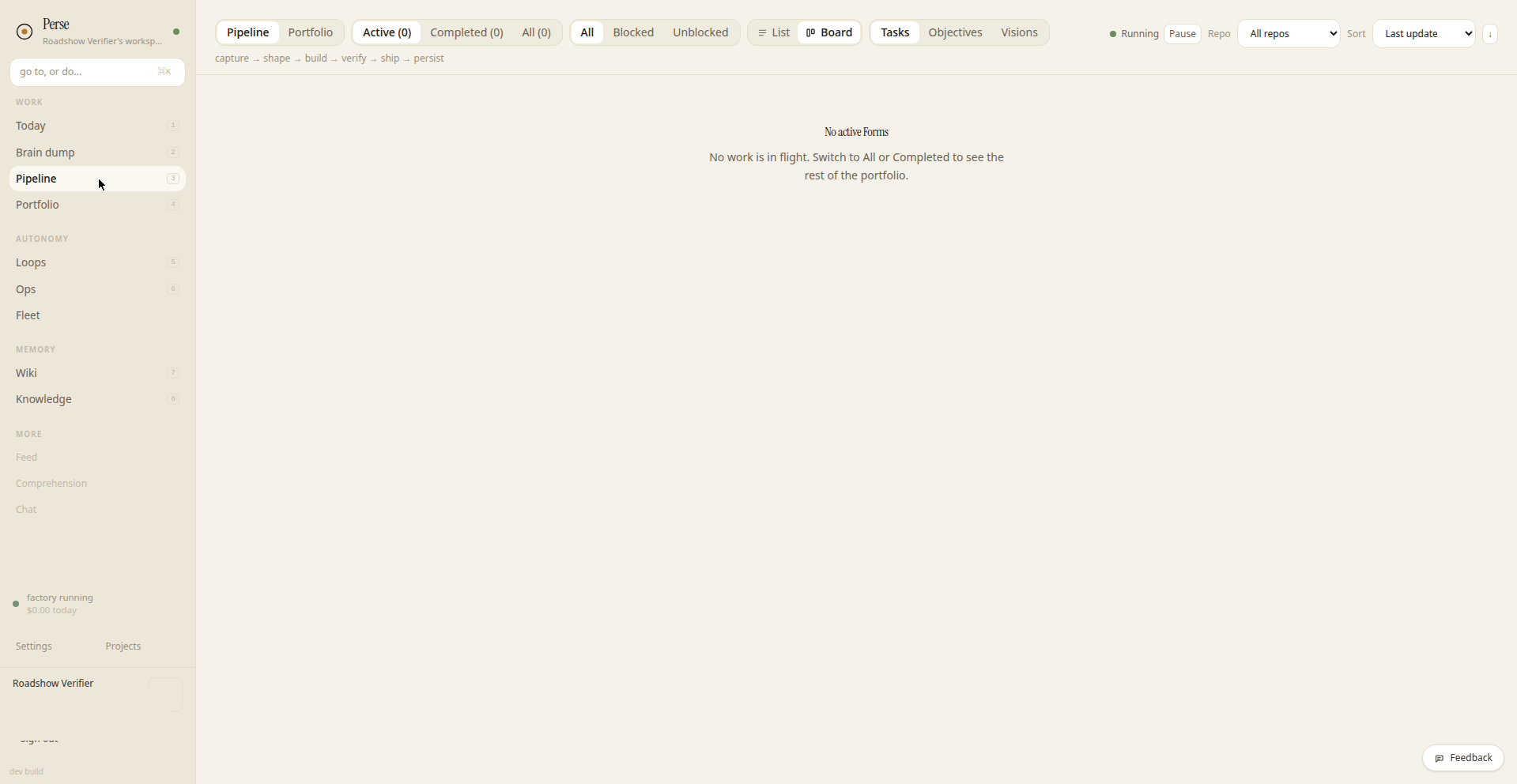
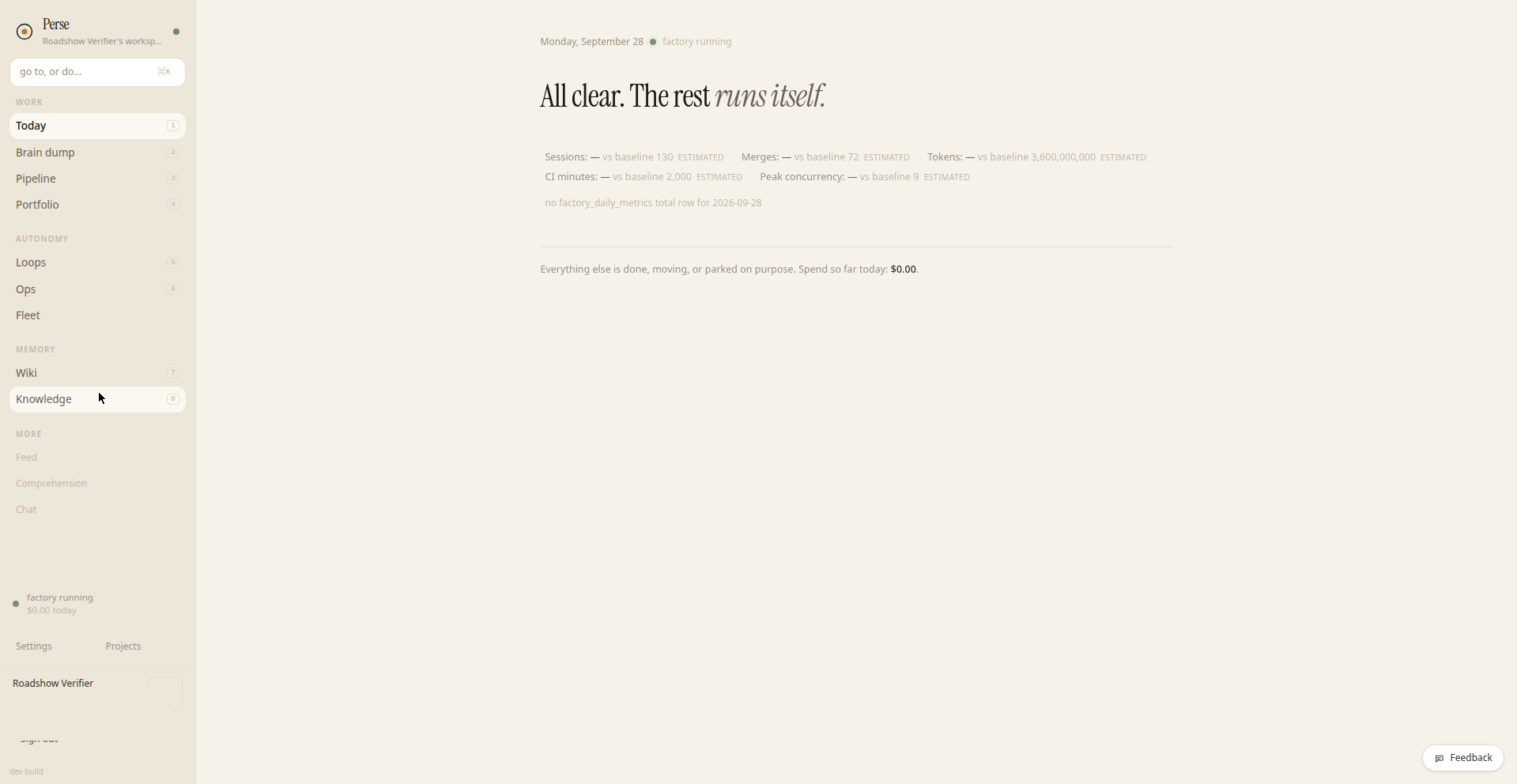
Measured: pull requests merged through the loop, counted from GitHub and refreshed on a schedule. Every change must pass its tests and an automated review; changes to deployment, to what the loop may do, or to its written rules wait for the operator to read them before they merge, and everything else merges once its checks pass and is read afterwards, with a revert path. The ledger records the merge, not the reading.
1,341 pull requests merged · as of 2026-10-14 · github search: repo:juliodavid8a/perse is:pr is:merged