Perse — coordinating AI agents from different vendors through one governed pipeline
An operating system that coordinates AI agents from different vendors through a shared work pipeline, with scoped permissions, human approval gates and an independent cross-model review before any merge.
- Entry
- No. 5 · 2026.5 · app
- Author
- Studio & loop
- Topics
- OS · Pipeline
- Status
- friends-and-family testing
- Front door
- Sign in (friends-and-family testers) →
/The problem
three lines/Architecture
the system, drawn/One decision
and the alternative it beatMemory lives in Postgres as insert-only records, not in the model’s context window. Every observation is written before the next step is taken.
Long-lived sessions carrying the state in context. Rejected because the state died with the session and could not be audited afterwards — the one property the whole system exists to provide.
/Three features
each a principle, and where it is enforcedThe supply of intelligence is separate from the authority over it: a non-deterministic model works inside deterministic controls that sit outside the model.
Inspired by public writing on treating models as insider risks. Evidence: the harness registry, lane verdicts and outcome receipts of this workspace.
Eight processes a strong model runs inside one context run instead as Perse structure, deterministically, at no token cost — so the judgment lives in the substrate, and a mid-tier model delivers at a top-tier rate.
Evidence: Perse amortizes max; the overnight run in which a cheaper model merged 33 PRs with zero reverts inside the substrate, while every orchestrator miss that week happened outside a Form (operator record, 2026-10-12).
Several harnesses work the same board at the same time, coordinating through shared artifacts rather than shared memory — stigmergy (coordinating through the shared record rather than by messages), the way ants coordinate through the environment.
Evidence: on 2026-10-12 a new harness took over this board end to end the same evening it first read the wiki, and its lanes shipped under the same gates (session ledgers, workspace wiki).
/See it
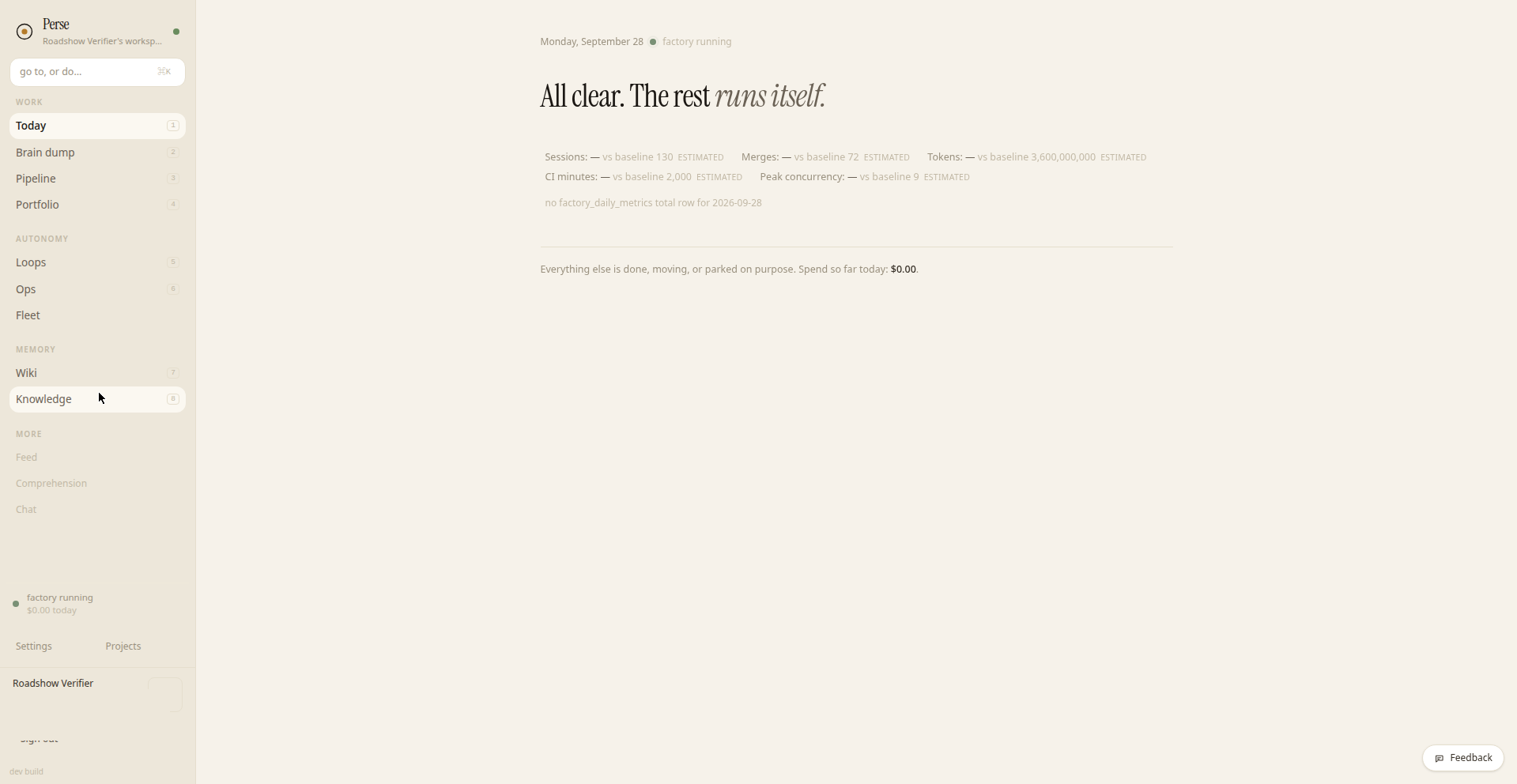
1 capture of the signed-in productReal frames from my own workspace, nothing private in view. Each one names the claim on this page it is evidence for.
/Measured, not claimed
what this page can and cannot vouch forMeasured: pull requests merged through the loop, counted from GitHub and refreshed on a schedule. Every change must pass its tests and an automated review; changes to deployment, to what the loop may do, or to its written rules wait for the operator to read them before they merge, and everything else merges once its checks pass and is read afterwards, with a revert path. The ledger records the merge, not the reading.
Across the studio: 3,595 merged pull requests across 17 repositories (Jan–Nov 24, 2026, verified 2026-11-24 14:28 ET).